


In the leadup to the 2003 Iraq War, Vice President Dick Cheney appeared on NBC’s Meet the Press to predict that American troops would be “greeted as liberators” and to dismiss any suggestion that several hundred thousand of them would be needed in Iraq indefinitely. The doyens of the foreign policy establishment disagreed. Consider this, for example, from Brent Scowcroft, national security advisor to Presidents Gerald Ford and George H.W. Bush: “Once you get to Iraq and take it over, take down its government, what are you going to put in its place? That’s a very volatile part of the world… It’s a quagmire if you try to take over Iraq.”
Actually, sorry – that wasn’t Brent Scowcroft. That was Dick Cheney. In 1994. How did Cheney go from circumspect realist to enthusiastic neoconservative in fewer than 10 years? If you believe what’s portrayed in, say, the film Vice, the answer is that he was never a realist to begin with. He was never anything other than a vessel for avarice.
Perhaps. But there’s another, at least equally plausible explanation for what happened between 1994 and 2003: “Events, my dear boy, events,” as the British Prime Minister Harold MacMillan once quipped. Cheney said as much during his Meet the Press interview, pointing to a “new and unique set of circumstances” that arose after 9/11, dictating far less tolerance of even the potential for a terrorist threat. The notion that such an epochal event would lead to a shift in Cheney’s worldview certainly strains credulity less than Barack Obama’s opinion on gay marriage coincidentally “evolving” in perfect alignment with his voters’.
And, yet, an Obama-like evolution by Cheney is a possible explanation, too. The Republican base of 2003 was more comfortable with the assertive, independent use of American force abroad – including for ideological purposes – than it had been for decades. Did Cheney, like Obama, suddenly discover within himself an orientation he’d long held? Or, did he simply triangulate a new one that was more popular with his base? Fortunately for him, there was already an established, if latent, framework for a damn-the-torpedoes style Republican foreign policy, hearkening back to the party’s 1960s standard-bearer Barry Goldwater and to Teddy Roosevelt before that.
2026 has brought to us yet another large-scale deployment of American forces in the Middle East – this time under the authority of a Republican president given to conflicting pronouncements and whose true foreign policy orientation is hotly debated. We are at an inflection point, a time of flux – an apt moment to reflect on three things.
First, political parties are not static. Their ideologies not only evolve over time, but do so in a way that resembles an “echo of the past in the future,” as Victor Hugo put it. Just as George W. Bush-era neoconservatism was not foreign to the DNA of the Republican Party 20 years ago, neither is Donald Trump-era transactional nationalism today.
Second, parties change because events actually do change people’s minds. For over 50 years, Democrats believed in the perfectibility of society via the new “science of management.” Then Vietnam happened, and Americans saw what war looked like when it was run by a bunch of MBAs. When the scion of the post-Vietnam Democratic Party, Bill Clinton, arrived in the White House two decades later, he brought with him a skepticism of managerial bureaucracy and famously declared, “The era of big government is over.”
Third, parties change because coalitions are fluid. Per a recent Manhattan Institute poll, a full 29 percent of Americans who are either now registered Republican or voted for Trump in 2024 had never voted for a Republican presidential candidate before. Many are former Democrats. If you expected them to have a moderating influence on the party, you’d be mistaken. These new entrants are significantly more likely to agree with statements like “society has become too feminized,” to believe in conspiracy theories ranging from the moon landing being staged to 9/11 being an inside job, and to justify the use of violence against their political opponents. They also oppose many of the views held by core GOP constituencies on free market economics and traditionalist social policy.
This doesn’t surprise me. I run a conservative political organization in San Francisco – one of the bluest blue cities in America. I spend much of my free time selling both conservatism and “big-R” Republicanism to people ensconced in leftist bubbles. More often than not, I find that the Democrats I speak to know very little about who Republicans are or what we believe. But I also find that, among those in my own camp, the more likely someone is to throw around terms like “RINO,” the more likely he or she is to have joined the GOP very recently and to have very little knowledge of its history.
Given where I live and what I do, then, allow me to propose that I’m uniquely qualified to chart the anatomy and heritage of the GOP to Democrats and new Republicans alike. Who are we? Where did we come from? What are the factions and movements in our party? I’m not the foremost expert on these topics. But I reckon I’ve had more practice than most explaining them in a digestible way to lay audiences. I know what works, and what doesn’t.
You be the judge.
Before we begin
A couple of brief historiographical notes: First, to understand today, we must first understand yesterday. Political ideologies are path dependent – shaped by an alchemy of current events and sincere inquiry, but always in dialogue with the ideologies that preceded them. Thus, what follows is a history. In each era, I illuminate the ideas and motivations of the primary factions in the Republican Party and tie them both to what came before and what came after.
Second, I divide the history of the GOP into five eras: 1828-1860, 1861-1912, 1912-1944, 1945-1994, and 1995-today. These eras do not correspond neatly to those favored by scholars discussing the entire sweep of American political history. That history is commonly divided into successive “party systems” (we are currently in the sixth or the seventh of these systems, depending on whom you ask).
My charitable explanation for this incongruity is that my chronology is determined by the emergence and resolution of ideological battles within the Republican coalition, while the party systems are determined by interparty (rather than intraparty) dynamics. My slightly less charitable explanation, if you’ll indulge me, is that the party system chronology is the product of a liberal academic establishment that mistakes trends in the Democratic Party – and on the left more broadly – for trends in American politics. As I mentioned earlier, I hope this essay provides a necessary corrective to such misconceptions and biases.
1828-1860
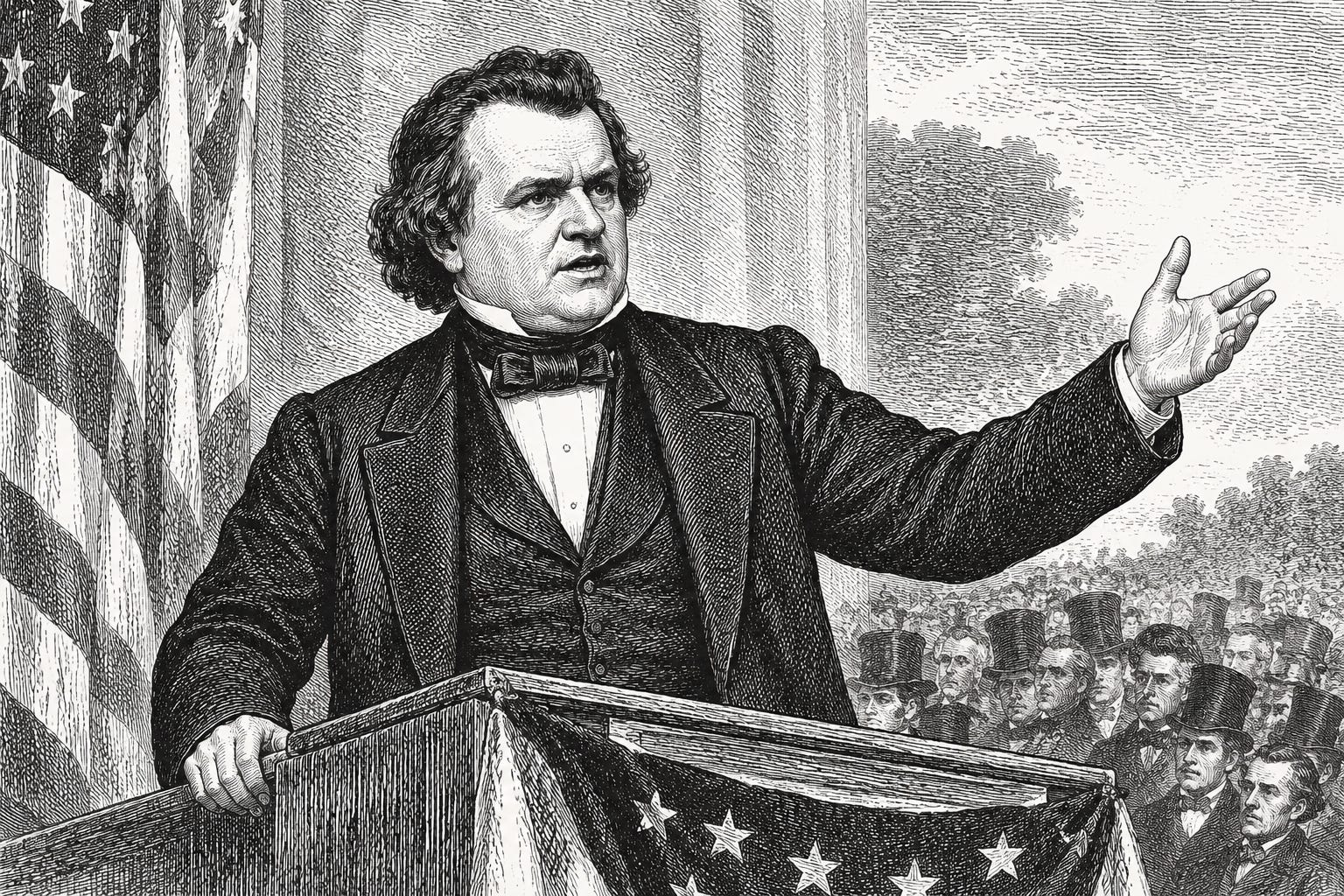
The GOP started out as the party of big government. Yes, much ado is made by us about our roots as abolitionists – and there is truth to that – but neither freeing the slaves nor securing political rights for southern blacks lasted very long as an organizing principle. Instead, the Republican Party was born from a marriage of convenience – or, more accurately, necessity.
From the 1830s to the 1850s, America operated under the Second Party System. On one side stood the Democrats, champions of “the common man”: small-plot farmers and cottage industrialists who hated taxes (the primary tax mechanism of the era – tariffs – made the finished goods they purchased more expensive), coveted new and “free” land for settlement in the West, and, viewing the distant federal government in Washington with suspicion, argued that the Constitution limited it to expressly enumerated powers.
On the other side stood the Whigs, devotees of the “American System.” The Whigs’ base of northern manufacturers and southern planters benefited immensely from tariffs, which protected domestic factories against foreign competition and financed massive public works that lowered transportation costs for raw materials grown on plantations. Since these public works required large sums of direct investment, Whigs argued for an expansive national government implicitly empowered under the Constitution to extend credit and steer the economy.
The stability of the Second Party System rested on the Missouri Compromise, which drew a line across the Louisiana Purchase. Below that line, slavery was permitted; above, it was not. This allowed regional factions within each party to maintain a cold peace with one another. Slavery being a settled issue, there was no point in fighting about it.
Then, with remarkable speed, the System collapsed. The annexation of new territories to the US following the Mexican-American War, the heated controversy over where – North or South – to route the first transcontinental railroad, and a hardening opposition to slavery in the North surfaced irreconcilable differences between and within each party’s factions. Finally, in 1854, Democratic Senator Stephen Douglas, who for more than a decade had spearheaded legislative compromises holding the System together, made a fatal error by introducing the Kansas-Nebraska Act, which partially repealed the Missouri Compromise and turned the slavery question in Kansas and Nebraska over to their territorial populations under the doctrine of popular sovereignty.
Both parties fractured. An exodus of “Free Soilers” – white laborers and yeoman farmers who primarily opposed slavery due to its depressive effects on their wages – from the Democratic Party left it dramatically smaller and weaker. But the party survived because unity among its factions did not require agreement on national policy. To the contrary, Democrats wanted there to be as little national policy as possible, so notions of popular sovereignty and states’ rights jibed with their underlying logic of local control.
The Whigs, on the other hand, suffered a mortal blow. Their unity did require agreement on national policy, because in their view all policy should be national. Now, every major piece of legislation – from which states to admit to the union to which ones would receive infrastructure investment – became a battle of wills between anti-slavery northern Whigs and pro-slavery southern ones. When large numbers of southern Whigs defected en masse to join the Democrats, the Whig Party could no longer muster enough votes to remain competitive.
While official party leadership was paralyzed with indecision, panicked Whig activists began to spontaneously re-organize themselves in local meetings across the North. They were soon joined by Free Soil Democrats looking for a new home, and then by emissaries from the fledgling American Party – the “Know-Nothings” – a secret society of nativists who shared the Whigs’ moralizing politics and their desire to protect the economic status of middle-class whites.
These three factions coalesced into a new, Republican, party, with opposition to slavery as its organizing principle. It was the first example of true grassroots organizing in American politics and arguably still ranks as the most successful. Just two years after the party’s first convention, it nominated a candidate for president – John Fremont – who carried 11 states and a third of the popular vote. Four years after that, Republican Abraham Lincoln won the White House.
The players
Northern Whigs: Radical abolitionists and northern manufacturing interests that favored expansive, but subordinated, big government
Free Soil Democrats: White laborers and yeoman farmers whose mantra was “free soil, free labor, free men”
Know-Nothings: Anti-Catholic, anti-German, anti-Irish, and anti-immigrant northeastern “Protestant supremacists” who saw both the Pope and southern planters as part of the same foreign, aristocratic cabal subverting American democracy
Their legacy
Northern Whigs were the forerunners of the mid-20th century Republican establishment, favoring a symbiotic relationship between big government and big business.
Free Soil Democrats contributed Jacksonian populism, Jeffersonian agrarianism, strict constitutionalism, and an appetite for territorial expansion to the party.
Know-Nothings previewed today’s National Conservatives, marrying nativism with a reforming social traditionalism emphasizing education, temperance, and moral virtue.
1861-1912
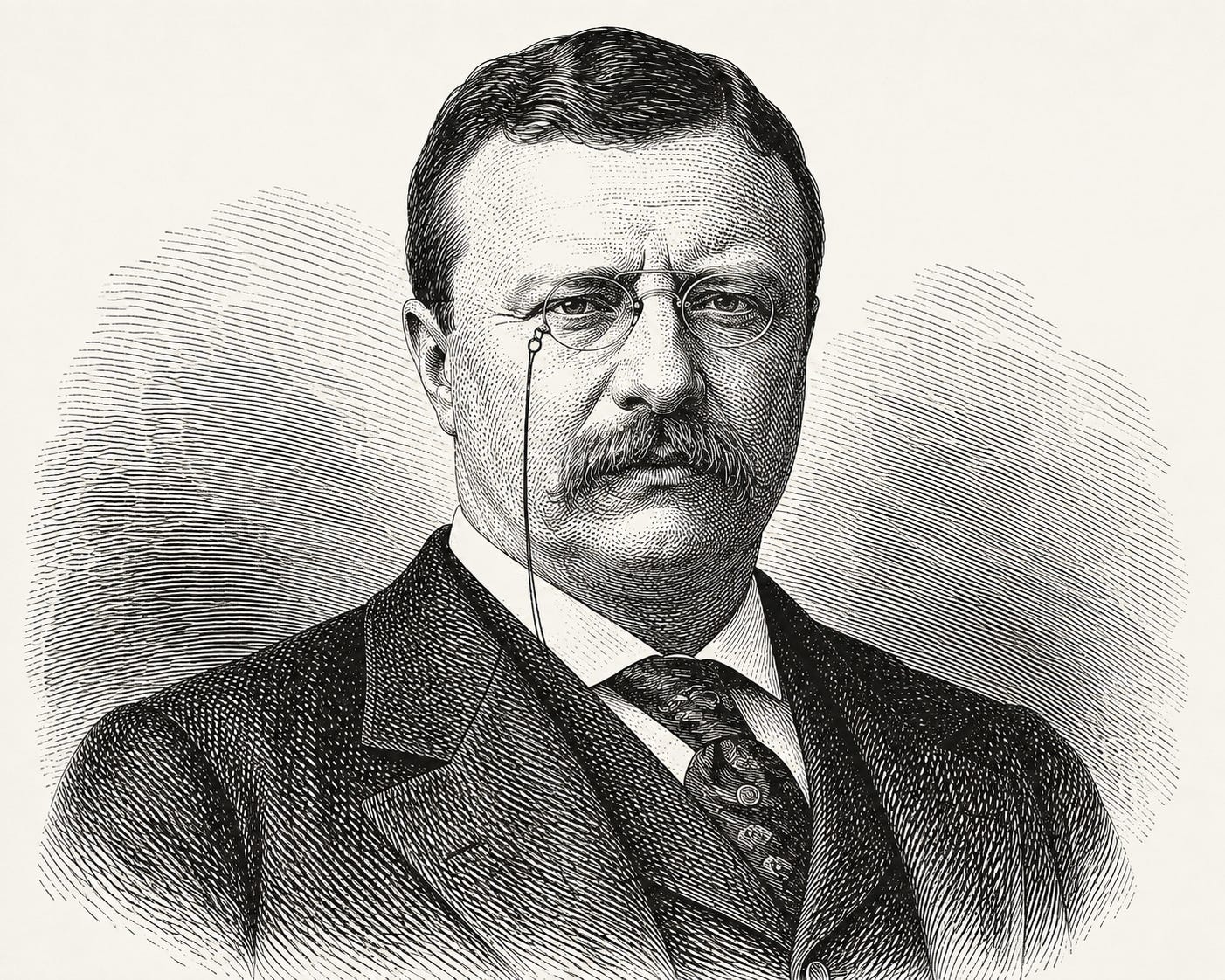
Before the GOP, there was the GAR – the Grand Army of the Republic, a fraternal organization of Union veterans so closely aligned with the party of their old general, Ulysses Grant, that newspapermen would joke that GAR actually stood for “Generally All Republicans.”
At its zenith, the organization’s membership was larger than the populations of 14 states and six territories. For obvious reasons, then, keeping the GAR (and its 400 thousand members) happy was the highest priority of the postwar Republican Party. The highest priority of the GAR, in turn, was the continued funding of Civil War pensions, which consumed nearly half of the federal budget.
Fortunately for the GOP this was less of a problem than a solution. Republican administrations were constantly under pressure to lower the tariffs that insulated northern manufacturers – still a key party constituency – from foreign competition while hurting consumers. Pension obligations offered a convenient, patriotic rationale for why those tariffs were necessary: the federal government simply had no other way to raise so much cash.
The sums involved, alongside the sprawling bureaucracy for administering the tariffs, invited an orgy of corruption. What followed was a massive expansion of the existing “spoils” system, in which party activists would whip votes (legally or otherwise) to get a politician elected who would then return the favor by appointing those activists to posts like Collector of the Port of New York, where they could skim cash and appoint their own cronies to positions beneath them.
Thus, corruption and the battle against it was the axis around which Republican politics turned in the post-Civil War era, during which the GOP organized itself into three camps. The Stalwarts operated the spoils system, and were heirs to the Whigs’ politics of cooperation between big government and big business. The Half-Breeds favored moderate reforms to root out corruption – for example, by requiring civil service applicants to pass standardized tests, not just show partisan loyalty. Finally, the Mugwumps emerged from a contemporary intellectual renaissance in New England that advocated for free trade, limited government, and fiscal restraint.
One can readily surmise which faction was doing the naming, with “Stalwart” evoking one who is loyal, robust, and unwavering; “Half-Breed” being the “RINO” of its era; and, most amusingly, “Mugwump” being the Algonquin word for “big chief” – a jab at the perceived self-righteousness and self-importance of the journalists, academics, and professionals comprising that faction.
In 1884, the party nominated James Blaine for president. Blaine was a Half-Breed with a reputation for corruption that rivaled even the Stalwarts’. Opposing him was Grover Cleveland, a Democrat. Derided at the time as the party of “rum, Romanism, and rebellion” (Irish immigrants, Catholics, and Confederates), Democratic leadership was nevertheless dominated by Cleveland’s “Bourbon” faction, whose politics were fairly similar to the Mugwumps’. Placing principle above party, the Mugwumps threw their support behind Cleveland, who became one of only two Democrats elected president between 1857 and 1932.
The Mugwump defection sent a shockwave through a GOP that had previously assumed its hold on national politics was unshakeable. The next tremor followed barely 12 years later. William Jennings Bryan rode a platform of “free silver” – currency inflation to help farmers pay back their debts – to the leadership of the Democratic Party. His agrarian populism proved wildly popular against the backdrop of Gilded Age wealth inequality and financial panics.
What did Republicans have to offer as an alternative? Nothing. For the second time in a little over a decade, the party was caught resting on its laurels – mistakenly assuming that the fading memory of Appomattox would carry it to the White House. Bryan’s precursoral socialism and flirtation with anarchism so thoroughly terrified the Bourbon Democrats and Mugwumps, however, that in a reversal of 1884 they threw their support behind his opponent for the presidency, Republican William McKinley – who defeated Bryan in 1896 and again in 1900.
Alongside the newly arrived Bourbons and returning Mugwumps, a new political movement arose in the GOP: progressivism – a sunny, high-energy belief that society could be improved through technological innovation, government reform, economic regulation, scientific managerialism, and a divine responsibility to bring progress to the benighted world (by force, if necessary). This became the Republicans’ answer to the Democrats’ populism.
Progressivism was far removed from the Stalwart vision of government, but the popularity of the Progressives’ leader, Teddy Roosevelt, gave them the upper hand in Republican politics and won the GOP two more terms in the White House – first under Roosevelt himself and then under his hand-picked successor, William Taft.
When Taft later pivoted his administration back toward what was, by then, simply called “Old Guard” Republicanism rather than Stalwartism, Roosevelt threw an infamous temper tantrum that split the GOP in half. Failing to reclaim the party’s nomination in 1912, he opted to run for president under the banner of the new Bull Moose Party, taking most of the Progressive vote with him. In the end, his sole achievement was to torpedo both his own candidacy and Taft’s, opening a path for a progressive Democrat to become president.
The players
Stalwarts and Half-Breeds (the “Old Guard”): Heirs to the Whigs’ big-government politics, prioritizing high tariffs and Civil War pensions; initially championed an unrestrained spoils system, but ultimately promoted civil service reform
Mugwumps: New England intellectuals who advocated for free trade, limited government, and fiscal restraint
Progressives: Believed that rapid social progress could be achieved by a clean, transparent government leveraging technology and the new “science” of management to regulate the economy and expand American empire
Their legacy
As the long-term project of building up national infrastructure neared completion and the financing of pensions took priority, Old Guard Republicans moved away from one form of big-government politics toward another: business, not government, would henceforth steer the economy, but high taxes would underwrite a precocious welfare state. While this redistributive orientation faded among Republicans in the 1920s, its memory later allowed them to make peace with the New Deal’s permanence.
The Mugwumps never fit comfortably in either the Republican Party – among the early Stalwarts’ and Progressives’ economic interventionism or the later Old Guard’s redistributivism – or the Democratic Party – among the ascendant Socialists and populists who sought to both intervene and redistribute. This naturally hastened their demise, but though short-lived as a movement their impact was immense. They were the first spark within the GOP of a revived classical liberalism.
Progressivism was born from a desire to combat the excesses of the Gilded Age with something other than naked populism. Progressives borrowed heavily from the Mugwumps’ and Bourbon’s emphasis on reform, but jettisoned those factions’ distaste for big government. They absorbed the Know-Nothings’ nativism, but repackaged its cruder expressions as scientific racialism and “white man’s burden” imperialism.
1912-1944
Woodrow Wilson – who defeated Theodore Roosevelt and William Taft to become president in 1912 – shared Roosevelt’s zeal for economic intervention, but as a southerner he couldn’t abide the Republican Party’s commitment to tariffs. Even before the Civil War, tariffs were viewed by many in the South as ruining their region’s economy to enrich the North. Yes, they had been essential to build infrastructure for southern planters, but the plantations were long gone.
So arose the Progressive Democrats, their ranks swelled by Progressive Republicans whose departure from the GOP in 1912 not only left the Old Guard in charge, it initiated a spiral of oppositional politics under which Republicans became increasingly laissez faire and isolationist. This trend was reinforced by two additional developments. First, as the number of living Union veterans dwindled, so did the GOP’s reasons for supporting economic redistribution. Second, during much of Wilson’s presidency, it seemed to the average voter that the country was spiraling out of control.
Although the US’s entry into WWI enjoyed broad support, the conflict ultimately cost more than 100 thousand American lives. This grim toll was soon eclipsed by a Spanish Flu pandemic, during which more than half a million Americans died. Earlier in the decade, a massive influx of eastern and southern European immigrants coincided with a wave of anarchist violence and labor unrest, while the communist takeover of Russia terrified many that the same could happen in the US. Against this backdrop, Wilson’s big-government, internationalist progressivism came across as radical, destabilizing, and anti-American.
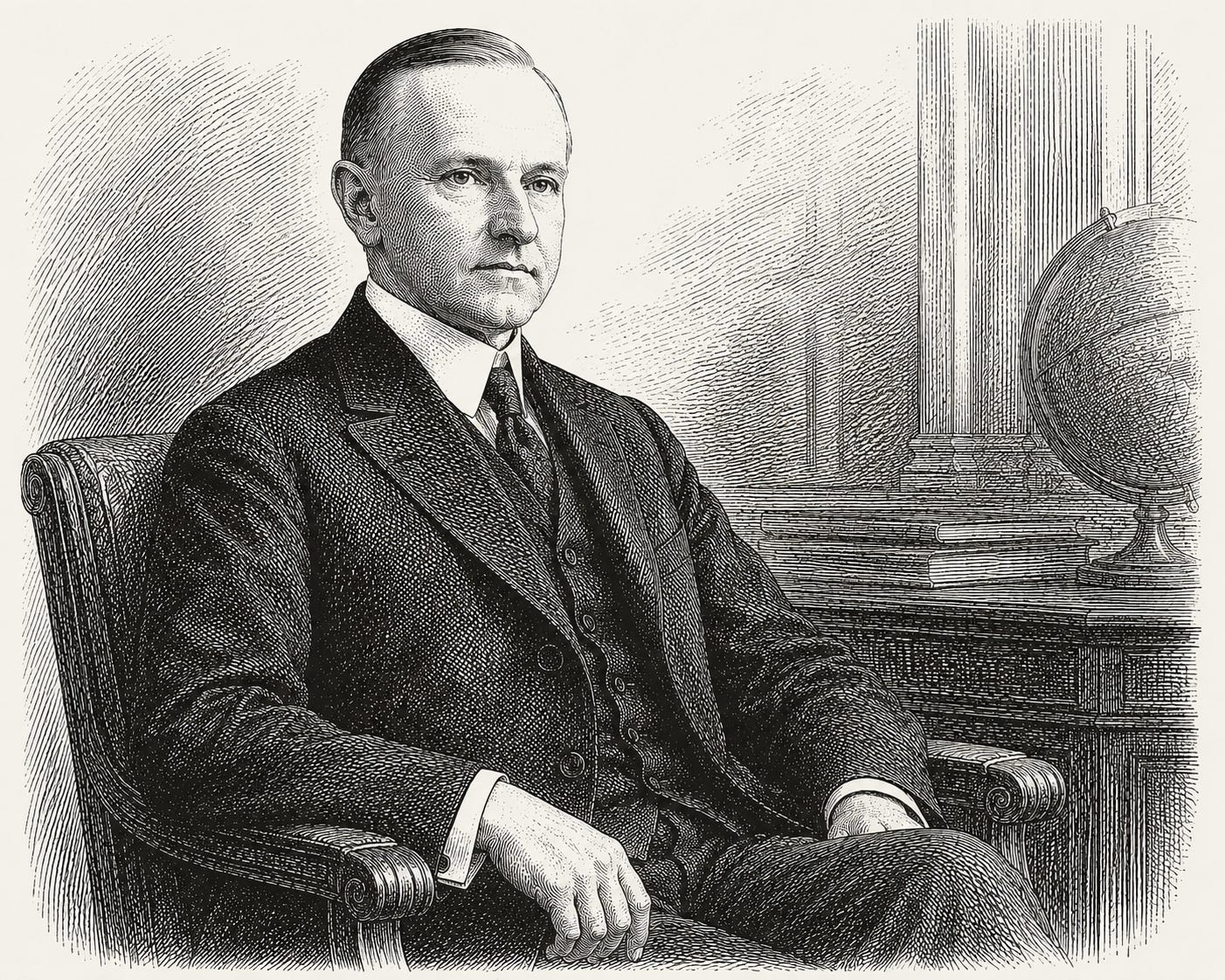
Warren Harding, Calvin Coolidge, and Herbert Hoover capitalized on this sentiment and took back the White House for the GOP in 1920, 1924, and 1928, respectively, promising voters a “return to normalcy.” But the party’s turn away from both redistributivism and interventionism was not just due to the vicissitudes of the zeitgeist; it also had ideological origins. It’s no accident that this is when Old Guard Republicans began to call themselves “Conservatives.”
In part, this was precipitated by the emergence of economics as a distinct, mathematically rigorous field of study in the 1890s, lending scientific weight to hitherto political arguments against big government. More importantly, however, the violent dissolution and reconstitution of polities in Europe around this time provoked in Americans a renewed appreciation for their own system of government and a renewed desire to conserve its animating idea: classical liberalism.
Liberalism, broadly, is a tradition arguing that individuals have intrinsic and inviolable value beyond their usefulness to or membership in a collective. The moral and political philosophy of liberalism as developed by John Locke and others during the Enlightenment is the water we all swim in today – too ubiquitous to notice, so dominant that even collectivist philosophies justify themselves as a means toward the ultimate end: the welfare of the individual.
As with any successful intellectual tradition, however, Enlightenment liberalism almost immediately developed schisms – the most fundamental of which distinguishes between social rights theory and natural rights theory. Proponents of social rights theory argue that a “right” – at least as the term is commonly understood – can only exist as a property of a specific social context. It makes no sense to talk about rights as existing outside of society. Against whom would such rights be enforced? To whom would they be petitioned?
Social rights theory, therefore, does not require a radical break from the pre-Enlightenment political order, which divided society into (roughly) a nobility and a commonfolk. Within this order, the ultimate source of political power was the kingdom or the polity. The monarch at the head of the kingdom or the government representing the polity could choose to devolve elements of that power in the form of rights to the general populace. Accepting this framework, social rights liberals simply direct the devolution to benefit the individual. Their first question in response to any societal problem is “What should government do?”1
Social rights theorists generally answer this question in one of two ways, implicating negative liberty on the one hand and positive liberty on the other. In simple terms, negative liberty is freedom from; positive liberty is freedom to. The Declaration of Independence offers an elegant formulation of a negative liberty answer: government’s responsibility is to protect the fundamental rights of “life, liberty, and the pursuit of happiness” from outside interference. In practice, this usually translates into support for the socialization of national defense, public safety, disaster relief, and baseline economic security.
Positive social rights liberalism, conversely, argues that government should not merely protect fundamental freedoms, it should strive to give individuals new ones – to realize, through government action, a world in which no one is ever denied anything and nothing is ever out of reach. How? The most straightforward application of this answer – give each person unlimited resources and allow him to do whatever he wants – is obviously impracticable. Resources are scarce; one person’s actions may hinder another’s. Allocation decisions must be made.
The various cadet philosophies housed within positive social rights liberalism may be distinguished, then, by their systems of allocation. Some are technocratic, such as the philosopher John Rawls’ famous “veil of ignorance” – a thought experiment that asks you to design an economic system without knowing in advance whether you’d be a relative “winner” or “loser” under it. Others are more metaphysical, such as socialism, Marxism, and various forms of progressivism that emphasize one’s freedom to actualize one’s “true humanity” – from which we are purportedly alienated not only by capitalism, racism, colonialism, etc., but also by our own misbegotten desires and compulsions. These systems claim that there is a “paradox of choice” whereby decreasing your tangible freedom from increases your “higher” or “more evolved” freedom to.
In any case, there is no controversy among social rights liberals as to whether government has the authority to impose any of these programs – positive or negative, technocratic or metaphysical. They only disagree over the wisdom of doing so. Natural rights theory, on the other hand, rejects the social rights framework altogether, turning the pre-Enlightment political order on its head. Kingdoms and polities don’t devolve rights to the populace; they possess no rights of their own to begin with. Rather, each individual is the ultimate font of political power, freely alienating his rights to the government at his discretion.
To what end? Again we turn to the Declaration, which tells us that all men are “endowed by their creator with certain unalienable rights … [and] To secure these rights, governments are instituted among men, deriving their just powers from the consent of the governed.” In other words: Rights exist outside of society because they are properties of something more fundamental. For many natural rights liberals – and certainly for those who originated the theory – that “something” is the covenant between God and man. The threshold question, then, is not, “What should government do?” but, “What may government do?” and the answer is, “Whatever its citizens have allowed, and only what its citizens have allowed.” That may involve promoting positive liberty in some cases and securing negative liberty in others.
If this all sounds like the vocabulary of contract, that’s because it is. The American Founders were deeply influenced by Thomas Hobbes and (to a lesser extent) Jean-Jacques Rousseau, who conceived of the state as a social contract freely entered into between citizens. There is a problem inherent to this concept, however. What is the status of the first child born after the contract is ratified? The state could automatically subject him to its jurisdiction – but that’s hardly a contract “freely entered into.” Or, it could render him an outlaw (or even exile him!) until he is ready to accept the contract and become a citizen himself – but that’s both impracticable and destabilizing.
Among the Founders, Thomas Jefferson took this problem most seriously, going so far as to claim that the legitimacy of a state naturally fades over time:
[The living generation] are masters too of their own persons, and consequently may govern them as they please. But persons and property make the sum of the objects of government. The constitution and the laws of their predecessors [are] extinguished then in their natural course with those who gave them being.
This is perhaps the earliest written articulation of anarchist philosophy in America. It was not, however, a popular view among the Founders, who instead staked out a middle ground that ultimately came to define what we now call classical liberalism. As natural rights liberals, they conceded that, yes, it is both true and, strictly speaking, an injustice that future generations become subject to the jurisdiction of a state without having freely entered into the social contract. But the alternative injustice is greater: perpetual instability in which, as Hobbes put it, life would be “solitary, poor, nasty, brutish, and short.” Thus, a compromise: Mitigate the injustice of nonconsensual jurisdiction by limiting government to those duties and powers deemed essential – not essential to the realization of some social objective, but to the very existence of government itself.
What duties and powers are essential is a matter of continuing controversy. Among the GOP’s early Conservatives, consensus existed for ensuring the rule of law, providing for disaster relief, financing public goods and services, and promoting institutional continuity. If this sounds like an expansive list for a movement committed to small government, that’s because it’s more accurate to describe the Conservatives of this era as committed to limited government. Thus, they often referred to themselves as “Constitutionalists” and saw no contradictions in a platform of high tariffs, low taxes, and (voluntary) coordination between government, industry, and labor. All this, in their view, was permitted by the Constitution.2
The beginning of the end for the ur-Conservatives came on October 24, 1929, Black Thursday, and the onset of the Great Depression. Over the next three years, the stock market lost 90 percent of its value, national economic output dropped by 30 percent, and the portion of American adults with a steady job cratered to less than half. Nothing fell more dramatically, however, than the electorate’s regard for politicians whose response to such conditions sounded like philobabble; no one is interested in debating the finer points of Rousseau when children are starving. Americans voted out scores of Republican congressmen at the earliest opportunity, and replaced Hoover in 1932 with Franklin Roosevelt, Theodore’s cousin. Once again, a progressive Democrat was in the White House. Erst kommt das Fressen, dann kommt die Moral.
The 1930s were a partisan watershed, with the Roosevelt administration’s aggressive economic interventions and sprawling bureaucracy firmly establishing the Democratic Party as progressivism’s home. It was also the decade when black Americans became Democrats en masse, encouraged by leaders like Robert Vann to “turn Lincoln’s picture to the wall. That debt has been paid in full.” The remaining ties of the GOP to its Civil War past were thus severed – a rupture whose impact still resonates. Finally, the decade heralded the arrival of a new Republican faction: Resigned to the permanence of Roosevelt’s “New Deal,” the Liberal Republicans coalesced around the electoral strategy of “interventionism done better.” Their perceived habit of beginning speeches by emphasizing general support for New Deal policies, then offering superficial amendments, earned them the epithet “Me-Too Republicans.”
As usual, the truth was more nuanced. Roosevelt’s coalition included radicals and Socialists who saw economic intervention as a vehicle to promote the interests of labor. Liberal Republicans saw it, instead, as a tool to ensure the continued prosperity of what Coolidge famously described as the “chief business of the American people”: business. On a deeper level, Liberal Republicans saw New Deal policies as consistent with the essential compromise of classical liberalism. As Germany, Italy, Spain, and Russia were then showing the world, nothing was more “essential to the existence” of liberal democracy than a stable economy.
Events in those countries contributed in other ways to the fortunes of Liberal Republicans. Many Conservatives – including President Taft’s son Robert, a highly influential senator in his own right – held fast to isolationism, even as totalitarian movements began to swallow up countries and human lives at an industrial scale during the 1930s. For these Conservatives, isolationism wasn’t merely a return to normalcy after Wilson’s European adventures, it was a return to fidelity with the Founders’ original vision. No less a figure than George Washington had warned his countrymen of the dangers of “permanent alliances.”
But Washington’s words were chosen carefully; he did not view all alliances with suspicion, only permanent ones. His successor John Adams’ presidency was consumed with agitation both for and against war with France. And Thomas Jefferson, who also warned against “entangling alliances,” launched America’s first naval expedition – not on our coasts or even in our hemisphere, but against Muslim pirates in the Mediterranean. American troops spent the 1800s fighting in Mexico, Japan, Cuba, China, and the Philippines. Americans at the time knew this history. Many of them had living parents and grandparents who’d participated in it. Many others had friends and family in Europe, living under the shadow of Nazism. Yet again, no one wanted to debate Rousseau while the neighbor’s roof was on fire.
The upshot was that the GOP nominated candidates from its Liberal wing – far more comfortable with foreign intervention – for president in 1936, 1940, and 1944. Any hope that the Conservatives may have had for a resurgence was put to rest in 1941 when the Japanese bombed Pearl Harbor. Old Guard Conservatism had been overtaken by events.
The players
Conservatives: Old Guard Republicans with a stronger, more ideological commitment to limited government; dominated American politics throughout the 1920s
Liberal Republicans: Recalling the GOP’s long history with economic and foreign interventionism, the Liberal Republicans made peace with New Deal politics, offering voters in the 1930s an alternative, more business-minded, form of big government
Their legacy
The Conservatives’ rediscovery of classical liberalism ranks as among the most important intellectual developments in the history of American politics. Classical liberalism’s emphasis on limited government and its idealization of the Founders’ worldview continues to profoundly influence both elite and popular discourse in the Republican Party, as well as modern American jurisprudence. It is the foundation upon which fusionism, later the predominant ideology of the GOP, was built.
Often underappreciated, the Liberal Republicans’ emphasis on social stability, their prioritization of business interests, and their ideological agility provided the GOP with a blueprint for unifying diverse coalitions of around a core set of principles. This allowed the party to thrive in the fractured cultural landscape of the coming decades.
1945-1994
Of course, history continues. Conservatism waned, but did not die; and what struck Americans in the 1930s as ill-suited to the needs of their “modern” world proved over the coming decades to be not only apt, but necessary, to a modernity those Americans could not imagine.
The stereotypical narrative of the GOP’s postwar era charts the course of Liberal Republicanism first to its apogee in the 1950s under Governor Nelson Rockefeller and President Dwight Eisenhower, then to its ultimate demise in 1964 at the hands of a resurrected conservatism under Senator Barry Goldwater. This narrative is often punctuated by Rockefeller’s response that year to an aide who frantically asked him where the fabled legions of the well-heeled northeastern establishment had gone, now that they were most needed to nominate Rockefeller as the party’s presidential candidate: “You’re looking at it, buddy. I’m all that’s left.”
This makes for a good story, but it’s not accurate. Goldwater was nominated, but he lost the general election badly – with a lopsided popular vote revealing that millions of Republicans rejected him. In the coming decades, conservatism would produce one of the most popular and consequential presidents in American history, Ronald Reagan, but the Liberal Republicans put two of their own in the Oval Office, also: Richard Nixon and George H.W. Bush.
Conservatism did not finally triumph and Liberal Republicanism did not finally expire, rather, until the 1994 midterm elections that brought a tidal wave of Conservatives to Congress and gave the GOP simultaneous control of the House and Senate for the first time in 40 years. The party’s base had sent a clear message: no longer would the kind of Republican who supported regulatory expansion, as Nixon had, or tax increases, as Bush had, be acceptable.
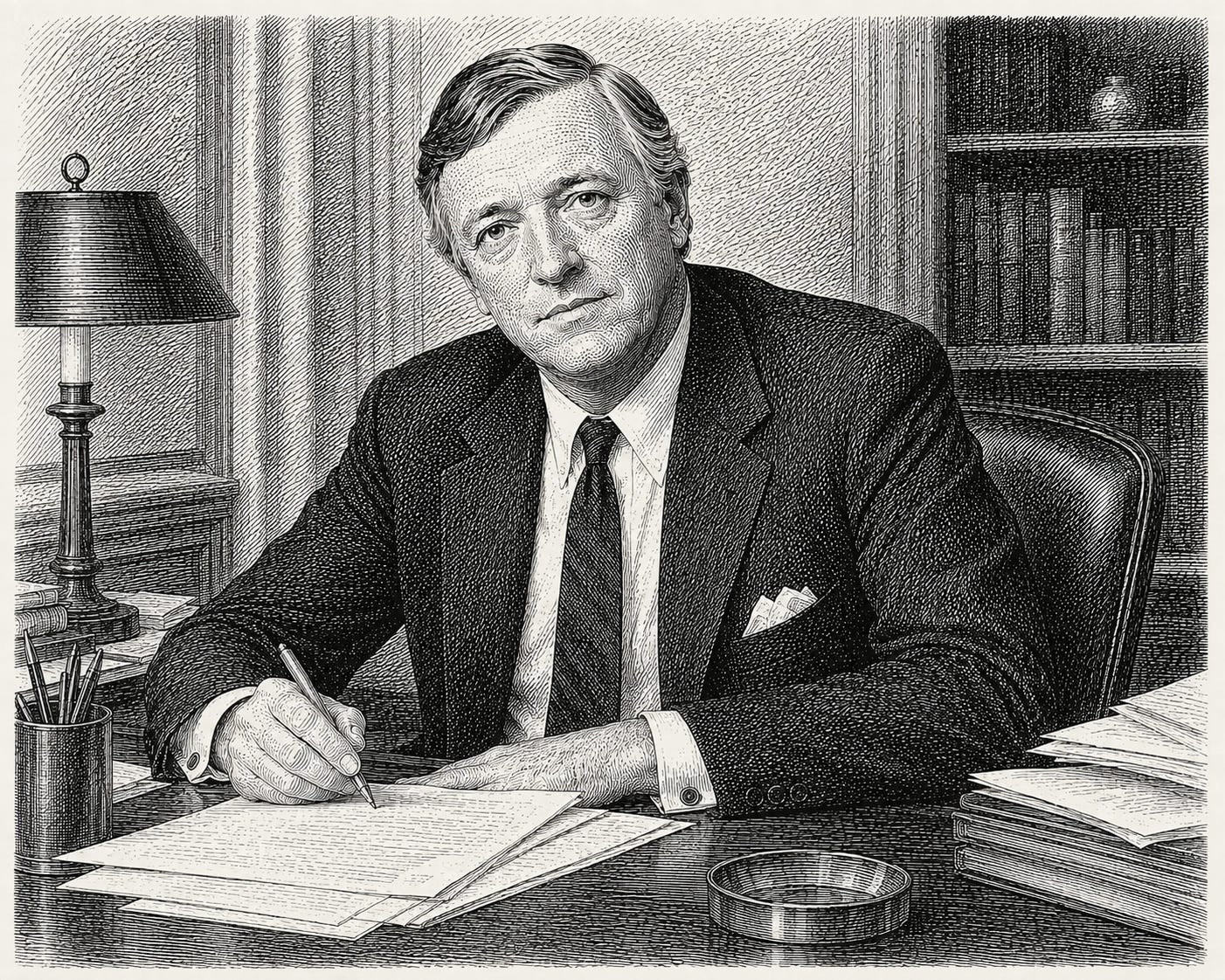
The true story behind this triumph is a colorful one of rogues, misfits, and refugees both to and from mid-century America debating and fighting and sabotaging one another – and ultimately coming together under the watchful eye of William F. Buckley.
Buckley not only brought them together; he kept them in line. Through National Review, the magazine he founded in 1955 and turned into the flagship publication of the conservative movement, Buckley defined over the course of the next four decades not just what, but who, was a conservative – wielding his immense influence to excommunicate the “kooks,” as he saw them, from the Republican Party. As the journalist Michael Malice has observed, what confuses so many of his colleagues writing about today’s “new Right” or “alt Right” is that it is not one faction, but a network of them with little in common other than ignominious membership in the “I was purged from the GOP by William F. Buckley” club.
Who did Buckley admit into that other, more rarified club – the one whose members overthrew the Liberal Republicans and became the new GOP establishment? Any and all who helped him with his life’s work: rebranding conservatism as intellectually serious, elite, and respectable. Following the Great Depression and WWII, this was seen by many as hopeless. The critic Lionel Trilling infamously wrote in 1950 that “liberalism is not only the dominant, but even the sole, intellectual tradition… The conservative impulse and the reactionary impulse do not, with some isolated ecclesiastical exceptions, express themselves in ideas, but only in action or in irritable mental gestures which seek to resemble ideas.”
Trilling could not have been more wrong. Conservatism’s 20 years in the wilderness had in fact produced an intellectual flowering; it was progressivism, rather, that had wilted. Yet his sentiments were not atypical. Despite growing dissatisfaction – particularly in the Sun Belt – with the definitively bureaucratic and seemingly collectivist politics that both parties had embraced, many voters believed there was no serious alternative. To an incurious partisan like Trilling – or, of greater concern to Buckley, to a low-information voter – the conservative movement did indeed resemble little more than a motley crew of misanthropic cranks.
The crankiest of all whom Buckley found, polished, and eventually brought into the fold were the Libertarians. During the 1920s and 30s, they were essentially a constituency of one: Albert Jay Nock, who left his wife and two children in 1909 to become a writer of books with sunny titles like Memoirs of a Superfluous Man. Later on, figures like Ludwig von Mises, Ayn Rand, and, more than anyone, Friedrich Hayek built Nock’s proto-libertarianism into a formidable political movement in America.
Libertarianism is a complex and variegated philosophy, but it fundamentally wishes to see the government reduced to a “night watchman” state whose authority is limited to prohibiting the use of force upon another’s person, property, or relationships. Some of the arguments that Libertarians advance are practical, building upon and extending the political economics of the early Conservatives. But these arguments are often paired with moral ones that venerate individual liberty. Many of the early Libertarians were Jewish refugees from Nazi Germany and Soviet Russia. They understood better than anyone that the essence of human dignity was, as George Washington wrote, each man’s right to “sit in safety under his own vine and fig tree and there shall be none to make him afraid.”
Closer to Buckley’s own sensibilities were the Traditionalists, who borrowed heavily from the English school of conservatism originally articulated by the 18th century statesman Edmund Burke and the 20th century Christian apologist G.K. Chesterton. In their view, social and political change, while not to be opposed reflexively, should only be effected in increments and with caution – lest the good be thrown out with the bad. Burke and Chesterton, in turn, were building upon the intellectual foundations of the English common law, which held that everyday practices and folkways contained hard-earned wisdom regarding the administration of daily life, and thus should be heeded in the administration of the law.
The unique contribution of American Traditionalists like Russell Kirk, whose book The Conservative Mind inspired the founding of National Review, was to add a spiritual dimension to these arguments: Traditions contained not just practical wisdom but transcendent moral and religious truths inaccessible to the new, “social” sciences. Virtue cannot be derived via logic and math, it must be discovered through lived experience or inherited from one’s ancestors. A society that ignores this is doomed to fail, no matter how free or wealthy it becomes.
This conviction resulted in the emergence from within the traditionalist movement (and other quarters) of the Anti-communists, the final addition to Buckley’s (and, later, Reagan’s) “three-legged stool” of conservatism. Though almost everyone in American politics during the 1950s – Democrats included – opposed communism, the Anti-communists were distinguished by the profundity of their opposition. Many of the leading Anti-communists were devout Catholics. In their view, communism was not merely a competing economic system, it was a disease of the spirit, turning societies against God and virtue. Thus, like any other disease, it could not simply be “contained” (as advocated by the postwar foreign policy establishment), it had to be eradicated.
Buckley saw in the Libertarians, the Traditionalists, and the Anti-communists exactly what he was looking for: serious men in gray flannel suits thinking seriously about statecraft. This was something he could sell to mid-century America.
Unfortunately, Buckley was a political entrepreneur saddled with a philosophical problem: how to reconcile the seemingly irreconcilable differences between three distinct schools of thought, uniting them under a single banner. Fortunately, one of his closest advisors had a solution.
Frank Meyer is the father of modern American conservatism, insofar as what Americans today call conservatism is, in fact, Meyer’s invention: fusionism. In his seminal work, In Defense of Freedom, Meyer agreed with the Traditionalists that virtue should be the ultimate end of politics, and that freedom itself has no intrinsic value. However, he nodded to the Libertarians by insisting that freedom, while not politics’ end, was its indispensable means – because virtue is meaningless if it is not freely chosen. Therefore, the sole function of the state should be to protect a demarcated sphere of human liberty within which virtue may be pursued. Furthermore, actions taken by the state against ideologies pernicious to liberty and virtue, such as communism, were not impositions on freedom, but defenses of it.
Thus, Meyer fused libertarianism, traditionalism, and anti-communism via a teleological re-ordering of means, ends, and practical implications. Fusionism resonated with the American founding; at essence, it was a 20th century update to 18th century classical liberalism – simultaneously venerating reason and liberty and contextualizing them alongside virtue and stability. It reconciled the two pillars of Western civilization: Athens and Jerusalem.
More importantly to Buckley, who published Meyer’s ideas in National Review, fusionism resonated with the American voter. Whether Meyer intended it or not, fusionism articulated what many Americans implicitly held to be the correct relationship between different fundamental values in a democratic society. That electoral resonance was embodied in the earthly form of Reagan, a president who spoke the language of libertarian economics (favoring deregulation and tax cuts), traditionalist morality (promoting family values and religion), and hawkish anti-communism (calling the Soviet Union an “evil empire” and stating that his Cold War strategy was “We win. They lose.”). Reagan trounced his Democratic opponents for the presidency twice, carrying 44 states in 1980 and 49 in 1984, and his coattails were so long that even his milquetoast successor, Vice President Bush, won the Oval Office with 40 states’ backing.
However, not everyone in the orbit of the Republican Party readily assented to the new gospel of fusionism. Many Libertarians and Traditionalists (including, notably, Buckley’s own brother-in-law, L. Brent Bozell) attempted to chart their own course. As we shall see in the next and final section, what success they’ve had has largely been the result of efforts to build influence within the GOP, rather than a new party outside of it.
The players
Libertarians: Originating as an obscure iteration of Mugwumpism, this movement of advocates for strictly limited, minimal government based on the “non-aggression” principle achieved mid-century prominence under the leadership of European exiles and American academics who formed the Mont Pelerin Society
Traditionalists: Importing the British intellectual traditions of Burkean conservatism and common law jurisprudence, the American Traditionalists added a distinctly religious (and particularly Catholic) spin to pragmatic arguments against radical social change
Anti-communists: Hailing from diverse ideological backgrounds, the Anti-communists were united in their fervent belief that the free world and communism were locked in a battle with spiritual implications, not merely a technocratic dispute
Their legacy
Libertarians, Traditionalists, and Anti-communists came together under the umbrella of fusionism to revitalize the dormant conservative movement in post-war America, ultimately leading to three decades of Republican political ascendancy beginning with the election of Ronald Reagan to the White House.
Both within fusionism and outside of it, each of its constituent parts continued to maneuver for influence. For example, after the fall of the Soviet Union, the Anti-communists evolved into and made common cause with the Neoconservatives, who favored actively confronting emerging threats to US interests across the globe and profoundly shaped George W. Bush’s presidency. The Traditionalists unsuccessfully sought the presidency under the banner of paleoconservatism via Reagan’s communications director Pat Buchanan, then turned their attention to judicial battles as political conservatism became more socially liberal during the 2000s. Libertarians mounted a series of third-party presidential bids, the most successful of which was Gary Johnson’s 2016 effort that garnered three percent of the popular vote. Nevertheless, libertarian energy within the GOP arguably drove the red wave of 2010, which elected scores of “Tea Party” Republicans to Congress.
1995-today

Now we have arrived at recent history, the retelling of which is uniquely vulnerable to the biases of the teller – who naturally has a greater interest in painting his contemporaries in a good or bad light than he does the long departed. Thus, caveat emptor: much of the below is my own interpretation of the intellectual currents within the Republican Party.
The first serious challenge to the fusionist consensus emerged in 2015 when Donald Trump announced his bid for the presidency. Distinguishing himself from the other candidates in a crowded Republican primary field, Trump capitalized on widespread discontent with both parties, evinced by the number of Democrats, independents, and first-time voters who supported him. His promise to these supporters was simple: Hypocritical, arrogant elites have stolen your birthright. President Trump will Make America Great Again.
In the Trump administration, however, populist sentiment has not always translated into populist policy – a dynamic that has led to incessant lamentations that Trump “is abandoning his base.” Interestingly, many of the voices in this chorus have been – or have been closely aligned with (as policy advisors, intellectual mentors, or political allies) – administration officials. These voices by and large emanate from three GOP factions that are dissidents from fusionism, each claiming to represent the true face of Trump’s “MAGA” coalition.
Far from harboring inchoate grievances, these dissidents advance specific, well-developed critiques of fusionist epistemology and politics. In the latter’s view, despite America’s immense wealth, unrivaled military, and various other markers of material distinction, there is something deeply wrong in 2026 with Americans. We are less religious, less patriotic, less self-reliant, and less familial. We are more resentful and more envious. We increasingly embrace pernicious social, political, and economic systems once rightly viewed as anathema. What’s most concerning: We have lost the shared ideological vocabulary that undergirds collective belief in our own system, and we no longer wish to realize that system in cooperation with one another. We live in a great country, but we are becoming a small people.
Having rejected the cultural inheritance of prior generations, we are dining out on the rapidly depleting stores of the material inheritance they bequeathed to us. And the cracks have already begun to show: a collapsing birth rate, corrupted civic institutions, crumbling infrastructure, runaway debt, housing shortages, failing schools, addiction, and “deaths of despair.”
This America, according to the dissidents, is the harvest of Leftism. Why, they ask, after nearly four decades of Republican electoral victories, does society look more Leftist than ever? Why are Democrats losing at the ballot box, but still winning the culture? The answer lies, they respond, with the Fusionists’ fecklessness (“conservatism is just progressivism driving the speed limit,”) and, in some cases, their betrayal of core American values.
The first dissident faction to expressly attach itself to Trump and MAGA were the Nationalist Conservatives (or “NatCons”) whose antecedents trace back to two reactionary movements that enjoyed brief electoral popularity in the 1990s. After the demise of the Soviet Union, many of the GOP’s anti-communists re-affiliated themselves with the so-called “Neoconservatives,” a cohort of socially liberal foreign policy hawks who joined the party in the 1970s and whose influence reached its zenith during the presidency of George W. Bush. That same demise also ushered in an era of international economic cooperation championed by a coalition of “neoliberal” Democrats and “supply-side” Republicans.
Those who were dismayed by this “rise of the Neos” responded by branding themselves “Paleoconservatives” and “Paleolibertarians,” respectively. The former argue for prioritizing national interests not only abroad, but at home, also. An implied premise of this argument is that a nation is something more than just the current inhabitants of a Westphalian jurisdiction or the atomized signatories to a social contract – otherwise “prioritizing national interests” collapses into the facile proposition that a government should do whatever is best for its voters.
Consequently, Paleoconservatives reject the notion that America is a credal nation, open to all and defined by a shared commitment to the principles of the founding. Instead, their America has much more in common with the nations of Europe, rooted in blood and soil and defined by the singular interplay of the ethnicities and heritages (Protestant, mostly white, particularly Anglo) predominant in the founding and building up of the country. What “prioritizing national interests” means, then, to most Paleoconservatives is “the survival and enhancement of a particular people3 and its institutionalized cultural expressions,” as the writer Sam Francis put it.
It may seem strange that Libertarians of any stripe, Paleo or not, would make common cause with those who believe the primary end of government is the preservation of traditional social relationships and moral strictures. But politics makes strange bedfellows, and the Paleoconservatives and Paleolibertarians shared two things often more important than teleological alignment: a common epistemology – populism, insofar as it argues that all political questions can ultimately be reduced to a conspiracy of elites against the masses – and a common enemy – “globalists,” insofar as they are presumed to be the primary elites of the modern era.
The NatCons took the rough ideas of the Paleos and polished them up for establishment consumption. Despite their antipathy toward William F. Buckley, they never hesitated to acknowledge his insight that intellectual respectability is table stakes for political success. Thus, populist affectations – flyfishing jackets and tales of hardscrabble upbringing – are now paired with elite credentials – Ivy League degrees and Wall Street resumes.
Straussians, the second dissident faction jockeying for influence in today’s GOP, agree with the NatCons that America is a nation, that nations are defined by a common culture and shared history, and that a state’s purpose is to further its nation’s cultural and historical interests (as well as its material ones). They disagree with the NatCons, however, that America is an ethnoreligious nation; it is fundamentally credal, like the Fusionists claim – but the Fusionists mistake the creed.
According to the philosopher Leo Strauss – from whom the faction takes its name – and, especially, his prized student Harry Jaffa, America is not exclusively rooted in Enlightenment reasoning nor is it exclusively defined by procedural freedom (as the Fusionists would have us believe). The Founders indeed drew inspiration from Locke and Rousseau and Hobbes – but also from the ancient Greeks and Romans, Jewish and Christian biblical figures, and even medieval and Renaissance clergymen on both sides of the Catholic-Protestant schism. Alongside freedom and rationality, the Founders placed “revealed” concepts like truth, beauty, fraternity, and virtue. In fact, the Straussians point out, Enlightenment liberalism itself was conceived as a logical corollary to the fundamental Judeo-Christian premise that man was created in the image of God.
Straussians argue that fusionism conspicuously overlooks this history to offer a seductive peace between Jerusalem and Athens: if the former would only cede the public sphere to the latter, it would then thrive organically. Like the Traditionalists before them, the Straussians deride this worldview as dangerously naive. The ordered liberty and virtuous communities that fusionism promises will emerge in the absence of state action must, in fact, be cultivated by state action. A healthy adult who appreciates salad was once a sweet-toothed child made to eat his vegetables. This insight is intrinsic to the Constitution, a document expressly designed to constrain what its biblically literate authors saw as the fallen nature of man and what Immanuel Kant, writing in the same decade, observed to be humanity’s “crooked timber,” from which “no straight thing was ever made” – a now-canonical tenet of conservative epistemology.
These philosophical and historical antecedents are key to understanding the Straussians, who believe that the tension between Athens and Jerusalem is what produces flourishing societies. America’s exceptionalism is not only due to its credal nature, but the genius by which that creed holds the tension in balance.4 Accordingly, the Straussians claim that America actually has two foundings – the first articulated in the words of the Declaration, and the second in the actions of the Lincoln administration that gave those words their full meaning. Today’s moral and social decline does not result from elite failure to prioritize the interests of “heritage Americans” (per the NatCons), but collective failure to understand, preserve, and transmit the ethos of the two foundings.
The differences between the Straussians and the Postliberals, the third dissident faction, are nuanced. While the Postliberals are no less comfortable with the exercise of state power than the Straussians, they do not share the latter’s veneration of the American creed or, for that matter, America. This skepticism generally comes in two varieties. Some Postliberals believe that the Straussians’ historical analysis is errant. America is in fact, as the Fusionists claim, a thoroughly Athenian nation, conceived in word and deed to overthrow Jerusalem.5 Of course, whereas the Fusionists see this as a positive, the Postliberals see our constitutional order as thus inherently corrupted. Others arrive at the same moral conclusion by conceding the Straussian account of the founding: It does place Athens and Jerusalem next to each other – and this is the original sin of America, because Jerusalem should take precedence.
The NatCons’, Straussians’, and Postliberals’ common advocacy of expansive and robust state action to address their populist – and sometimes identitarian – complaints has earned them the collective moniker “woke right” among their detractors. This may be rhetorically powerful, but it elides some illuminating disputes between the factions.
For starters, NatCons and Straussians are liberals – positive social rights liberals, like their counterparts on the Left, but liberals nonetheless. The Postliberals, obviously, are not; but to dismiss them as merely “illiberal” is to evince a shabby lack of curiosity about and respect for why they chose their name. The Postliberals neither affirm nor deny the inherent and inviolable value of the individual. They place themselves “post,” or beyond, that discourse, insofar as what they’re interested in is natural right – how to live virtuously – not natural rights.
Another fault line arrays the Straussians and Postliberals against the NatCons. The latter are typically pluralists – they believe that different nations legitimately can and do have different interests and values (which, they say, is precisely why the state must prioritize the expressed preferences of its historically predominant nation) – while the former are typically universalists – they believe that there is only one truly righteous set of interests and values, which should override any tribal preferences to the contrary.
It should by now come as no surprise to the reader that debates over how to divine that “truly righteous set of interests and values” have led to even more schisms within and among the dissident factions. Some Postliberals argue a la Aristotle in favor of teleological alignment between public policy and human nature, particularly as one might observe in local, organically emergent customs and practices (“subsidiarity,” recalling both Burkean traditionalism and American federalism). Others insist that Aristotelian ethics are, by their own author’s admission, inherently amoral and that a religious foundation is necessary to distinguish good from evil. This foundation can take a spiritual form (e.g., the Stoic belief that conscience is the spark of godly will implanted in mortals) or an ecclesiastic one (e.g., integralism, which explicitly calls for a quasi-theocratic state). Straussians, for their part, look to the subtext of the Constitution to reveal America’s transcendent values. Their critics, in turn, charge that this sounds dangerously similar to “living constitutionalism” – a once-popular theory among progressive jurists that the law naturally evolves over time, with its spirit superseding its plain meaning. And on and on these debates continue.
By attaching themselves early to Trump, the dissident factions have propelled many of their exponents to senior positions in his administration – for example: Vice President J.D. Vance, Under Secretary for Policy Elbridge Colby, and former Director of Policy Planning Michael Anton. Why is it, then, that so many claims of Trump abandoning his populist base have come from the dissident factions he has elevated and not, well, his populist base? Why – despite such claims – does he continue to enjoy the unwavering affection of MAGA voters, and why does he retain an unparalleled ability to decide down-ballot elections with his endorsement or silence?
The answer, I believe, is that the dissidents mistake both Trump and MAGA – as well as today’s GOP more generally. He and they are certainly not Fusionists, but they are also not NatCons, nor Straussians, nor Postliberals, either. They are something different, driven by an entirely new political tendency. And if a philosophy, or a school of thought, or a faction is just a tendency not yet titled, let us now remedy this oversight.
I propose that the core of today’s Republican Party is “neofusionist.” They are Fusionists who take the dissidents’ critiques seriously, but not their diagnoses nor prescriptions. Yes, there is something wrong with Americans in 2026, but it is not the consequence of a fettered state’s “thin,” process-oriented, and value-neutral vision of the common good. To the contrary, polls of the MAGA electorate consistently show they agree with Ronald Reagan’s famous quip that the nine scariest words in the English language are: “I’m from the government and I’m here to help.”
If anything, MAGA voters are more, not less, enamored with personal freedom than the Fusionists – ranking it as an inherent good and not just a means to achieve virtue. Their opposition to big government is visceral, the product of a congenital American optimism that people will do amazing things if you just leave them alone, goddammit, and a congenital American orneriness that asks: Who gave you the right to force-feed us what you think are vegetables, anyway?
The neofusionist core of MAGA and the GOP agree with the NatCons’ robust definition of nationhood, particularly Hazony’s key element of a “a past history of acting as a body.” But Neofusionists are also decidedly credal. Polls show their affinity for how Reagan articulated American identity:
You can go to live in France, but you cannot become a Frenchman. You can go to live in Germany or Turkey or Japan, but you cannot become a German, a Turk, or a Japanese. But anyone, from any corner of the Earth, can come to live in America and become an American.
It is in fact this very exceptionalism that makes them intensely patriotic. America is “a shining city on a hill,” as John Winthrop, John F. Kennedy, and – yes, again – Reagan all invoked in famous speeches. Consequently, their nationalism is uniquely outward-facing, leading to high levels of continued support – contra the NatCons – for American global leadership and engagement.
And yet, despite these Reagan-esque affinities, Neofusionists also overwhelmingly support Trump, a president far removed from Reagan in both style and substance. This, I argue, can be explained by their departure from three of their predecessors’ key operating assumptions: first, pluralism in the public square can be maintained by gentlemen’s agreement; second, markets – whether economic or ideological – uniformly lead to positive outcomes; and third, the Western world is united, under American leadership, in pursuit of shared prosperity.
Even in the abstract, a neutral observer must admit these assumptions strain credulity. Agreements based solely on norms and lacking enforcement do not survive. They are immediately violated by the most disagreeable party. Nor is there anything to be found in the history of human experience to justify a Panglossian faith in the marketplace (of ideas or otherwise). Cognitive science, for example, has conclusively demonstrated that people do not reason by formal logic; we resort instead to various psychological biases that evolved over time to help us perceive, understand, and react to the world in ways that aid our survival. Thus, it’s often not the strongest arguments that win, but those that most effectively manipulate our biases. And as for internationalism and the concert of nations? Too many Fusionists clearly read only the title of Professor Francis Fukuyama’s seminal treatise, The End of History and the Last Man, assuming it to be a sort of Roman triumph for neoliberal democracy, while neglecting the entire latter part of the book in which Fukuyama elaborates on the many ways in which the fragile post-Cold War order could shatter.
The American experience of the 21st century bears out these objections, the Neofusionists argue. One needn’t resort to claims of a coordinated “long march through the institutions” by the Left in order to explain how practically all of the sense-making apparatuses of society, from journalism to religion to Hollywood to academia, have come to be dominated by a cadre whose political leanings are so radical and unrepresentative of the American electorate that they frighten even the most partisan Democrats.
Disagreeableness is a personality trait overwhelmingly localized in and represented on the Left, so it was inevitable that the Left would eventually violate the Fusionists’ gentlemen’s agreement. While conservatives were being told that it wasn’t polite to discuss politics and religion at the dinner table, the Left turned every public space, every pluralist organization, and every neutral institution from libraries to football games to children’s television into a contested ideological battleground based on the argument that, like it or not, “everything is political.” One struggles to think of a more on-the-nose example than a PAC recently launched by 2028 presidential hopeful Gavin Newsom to train activists on how to “naturally” introduce Democratic talking points into conversations with friends and family – quite literally: how to discuss politics at the dinner table.
Not only did Leftists’ disagreeableness yield an inescapable cacophony of their messaging in the public sphere, it facilitated their capture and repurposing of elite institutions. Hired, admitted, and appointed by dewy-eyed leaders in performative displays of ideological pluralism (“Wouldn’t it be interesting to have someone at the table whose values include the unequivocal censure and violent abolition of the table?”), Leftist journalists, students, and professors soon showed those leaders they had no intention of reciprocating the courtesy. Forming entryist blocs within their new institutional homes, their first act was to summarily ignore institutional norms like journalistic objectivity, honor codes, and scientific neutrality. Their next was to hound out the very same leadership class that welcomed them, along with any dissenters. And their coup de grace was to then assume leadership of the institutions themselves. The Left was never there to take part, it was there to take over. Among the more striking examples of this is the recent history of the Democratic Socialists of America, a now explicitly communist and implicitly antisemitic organization founded in large part by anti-communist Zionist Jews.
Thus, the gentlemen’s agreement of the Fusionists may have, for a time, afforded Americans a “kinder, gentler nation,” in the words of George H.W. Bush, but it ultimately amounted to conservatives’ unilateral disarmament. And because two of the most consequential psychological biases in belief formation are the perceived prevalence of a belief (a) among one’s peers, and (b) in elite discourse, the loudest and most disagreeable voices have pushed American public opinion farther and farther left. As the theologian Andrew Walker recently wrote, “The public square is never empty. Someone’s6 vision of the good always fills it.” Nature, human or otherwise, abhors a vacuum.
Nevertheless, the precipitous decline of Americans’ trust in institutions, the rising popularity of transgressive internet culture, and the increasingly common phenomenon of poll-defying electoral results all indicate that the observance of Leftist shibboleths is often driven by fear of social sanction, not genuine agreement.
This proved sustainable only for as long as it could be papered over with money. Per the journalist Christopher Caldwell: “The security of the working class had provided a margin for error for all the social experiments of the last half-century. By 2016, that margin was gone.” Rightly or wrongly, Neofusionists attribute that outcome in large part to increased social spending on immigration and, even more so, on the dramatic discrepancy between the human and material burdens assumed by the US to ensure our allies’ security and the burdens assumed by our allies themselves. Echoing the NatCons, they assert that while Americans have been laboring under an illusory global compact of shared prosperity, other countries have been doing business as usual: prioritizing national interests in conflict with ours and even attacking us rhetorically in cultural and diplomatic contexts – all from within the cool, dry shade of our global defense umbrella.
But none of this history, according to the Neofusionists, argues in favor of the dissenters’ program. To the contrary, the Fusionists’ practical assumptions were flawed precisely because they were so obviously inconsistent with their own foundational beliefs. If you’re going to argue that virtue is more effectively and organically promoted in the absence of state action, then you have to actually promote virtue. At the very least, you shouldn’t actively undermine it by promoting vice in the name of pluralism. And you certainly shouldn’t be oblivious to when ideological opponents exploit state power for their own purposes.
When the conservative movement has heeded these commonsense dictates, it has notched impressive victories. Consider the federal judiciary, for example. Fifty years ago, it was more Leftist than any other institution in America. Conservatives did not respond in banana republic fashion, defying court orders and arresting judges. They leveraged private resources to build a disciplined, elite talent pipeline of conservative law students who became federal clerks who became federal judges who restored the judiciary to its intended purpose: fidelity to the Constitution. The results speak for themselves: the end of race-based criteria in voting and education; broad Second Amendment protections; an increasingly subordinated administrative state; and, of course, the ultimate prize for religious conservatives – Roe v. Wade overturned.
In the final analysis, the Neofusionist program is Burkean: Don’t throw out the classical liberal baby with the enervated conservatism bathwater. Practically speaking, that program involves border enforcement and selective immigration quotas, industrial policy to discourage job turnover, legal action against foreign and domestic political and ideological manipulation, punishing discrimination against “privileged” groups in the private sector, leveraging public institutions and public funds to explicitly promote our national interest, culture, and customs, and global leadership paired with an insistence that our allies pull their own weight and occasionally, in Vance’s phrasing, “say thank you.”
If all that looks suspiciously similar to the agenda of the Trump White House, that’s because it is. MAGA is neofusionist.
Conclusion
Where does the Republican Party go from here? Based on polling data, it’s entirely possible that neofusionism will continue to be the dominant force in GOP politics for many decades. It is a Millennial phenomenon as much as – and perhaps more than – it is a Baby Boomer one, and Millennial voter participation will likely only increase going forward.The dissident factions’ perspectives are more popular among Gen Z voters, but it will be at least 15 years before they vote in numbers that can meaningfully swing elections. That, in politics, might as well be a century.
Some variant of Straussianism or postliberalism more compatible with the sensibilities of older voters could gain traction – like the “soft” postliberalism of the writer Rod Dreher and others, which recalls the “paradox of choice” philosophies we discussed earlier insofar as it argues that even if freedom is one’s ultimate end, then that, too, requires state-enforced virtue. A national conservatism that emphasizes ethnic germ theory less and America’s Protestant cultural heritage more is plausible, too. Or, perhaps, as we discussed at the beginning of this essay, events will intervene. A costly war could reinforce the NatCon argument for a more restrained foreign policy, or it could motivate an even more interventionist posture (as it did for the WWI generation). Something akin to the 1995 declassification of the Venona Cables – indicating intentional, widespread corruption and co-option of state apparatuses – could lend credence to the more “hard” postliberal claim that the current constitutional order cannot be salvaged (at least not by constitutional measures).
Alas, to quote Yogi Berra, “It’s tough to make predictions, especially about the future.” What I hope to have imparted to you here, rather, is not the tools to place bets on what comes next, but an appreciation for what has come before. And not merely an appreciation in the general sense, but more specifically one that disabuses you of two uniquely pernicious – and, sadly, widespread – notions: first, that politics is like a restaurant – you’re seated, you’re given a menu, and you have to choose from what’s shown on the right side or the left; and second, that politics is a grubby business.
Neither could be further from the truth.
Politics is a kitchen, and you can choose what to make for dinner. In fact, the political history of the US is very much defined by iconoclastic chefs who borrowed spices from neighbors, added unconventional ingredients, and sometimes served ice cream for breakfast. The only thing stopping you from eating what you want is you.
As for politics being grubby, the ancient Greeks had a word for a citizen who exempted himself from civic engagement – a word whose modern meaning retains traces of their contempt such a person: idiot. If this essay has done anything, I hope it has demonstrated to you that politics is, in fact, a grand tradition, to paraphrase the writer Roger Scruton, of sincere – and often great – men and women struggling with deep philosophical questions in service of their country. Phone banking, block walking, door knocking – it may not seem so, but these are noble undertakings in a democratic republic.
So, then, unto the breach, dear friends: get up, get involved, and get to work.
Some social rights theorists argue that while rights do not exist in a state of nature, interpersonal obligations do. Others insist that interpersonal obligations cannot be disentangled from the rights granted in a social context, such that by accepting rights from the polity one must accept concomitant duties. In any case, a key distinguishing feature of social rights theory is a belief that rights cannot exist in isolation from obligations.
An optional digression for the lexicographer: Liberalism, American conservatism, social rights, natural rights, Democrat, Republican – these are all terms with real, noumenal value, identifying fixed and coherent political philosophies, or evolving-yet-distinguishable political associations. “Left” and “Right,” on the other hand, are more problematic labels signifying entirely different things to different people in different countries at different times. They often reduce to a mapping of ephemeral religious, ethnic, and socioeconomic affinities – hardly surprising, given their origin in precisely that: the seating arrangements of the French National Assembly of 1789. Indeed, much of what is described as “Right wing” in Europe and thus lumped in with American conservatism is actually a positive social rights liberalism that is ideologically indistinguishable from the American “Left” – it’s just deployed to advance the interests of a different constituency. In other words: if American conservatism seeks to conserve the classical liberalism that animated the American Revolution, European conservatism typically seeks to conserve the social rights liberalism the Revolution was fought against. Alas, it is almost impossible to discuss modern politics, which are inherently oppositional, without invoking the Left/Right dichotomy – even if only as a shorthand. In this essay, I use the term “Leftism” to describe a particular strain of positive social rights liberalism that believes that, in our current political system: (a) moral distinctions (who is right and who is wrong) map neatly onto power distinctions (who is strong and who is weak); (b) power distinctions map neatly onto demographic distinctions (race, gender, religion, etc.); and (c) not only is reform of this monstrously unjust system impossible, but advocacy for anything other than wholesale abolition of the system and its constituent parts, and the proscription of its adherents, is abominable.
Emphasis added.
Strauss himself warned of the dangers of too much state action in his lecture Why We Remain Jews.
The Straussians discussed in the body of this essay are formally known as “West Coast” Straussians, to distinguish them from their – you guessed it – “East Coast” counterparts. It bears noting here in passing that the East Coast Straussians more align with the Fusionists in both their historical understanding and moral appraisal of the founding. I demur from elaborating further on their beliefs, both for the sake of brevity and because they are decidedly more academic and less political than the West Coasters.
Emphasis added.
Hi Jay- This is fantastic, I've never read such a summary of political evolution on the conservative side. Keep them coming!
Jay, I really enjoyed this. I love the sheer density of the education — the eras, players, and intellectual frameworks.
I can see more clearly the through line from the Mugwumps to today's Nikki Haley Republicans — the sober, fiscally-restrained, small-government, uncomfortable-with-populism temperament is still with us a century and a half later.
The Straussians have been confusing to me…now I better understand how they place among the “dissidents,” and where they agree and diverge from the NatCons and Postliberals (credal vs. ethnoreligious nationhood; universalist vs. pluralist).
Two comments:
- No real discussion of republicanism as its own tradition — distinct from the liberalism axis (natural vs. social rights, Athens vs. Jerusalem) the piece focuses on. Andy Smarick's 2024 National Affairs essay, Recovering the Republican Sensibility, makes the case directly: the founders cited Montesquieu and Blackstone far more than Locke, "republic" or "republican" appears 160+ times across the Federalist Papers, and our current woes (as seen from either the left’s or the right’s perspective) can be seen as stemming from republicanism's decline, not liberalism's triumph. The history of the Republican Party could also be described in terms of the waxing and waning and twists and turns of Smarick's five pillars of republicanism: self-rule and equality, civic virtue, democratic decision-making, the common good, and limited-but-active government.
- Whither modern populism? It shows up historically (Bryan, the Paleocons' shared "elites vs. masses" epistemology), but by 2015-2026 it quietly disappears into "neofusionism." Political scientists like Müller (What Is Populism?) define “populism” to mean something specific: anti-pluralism, a leader claiming sole legitimate voice of the people. Whether Trump fits that description seems like a live question your framework answers implicitly (no) without exploring it.